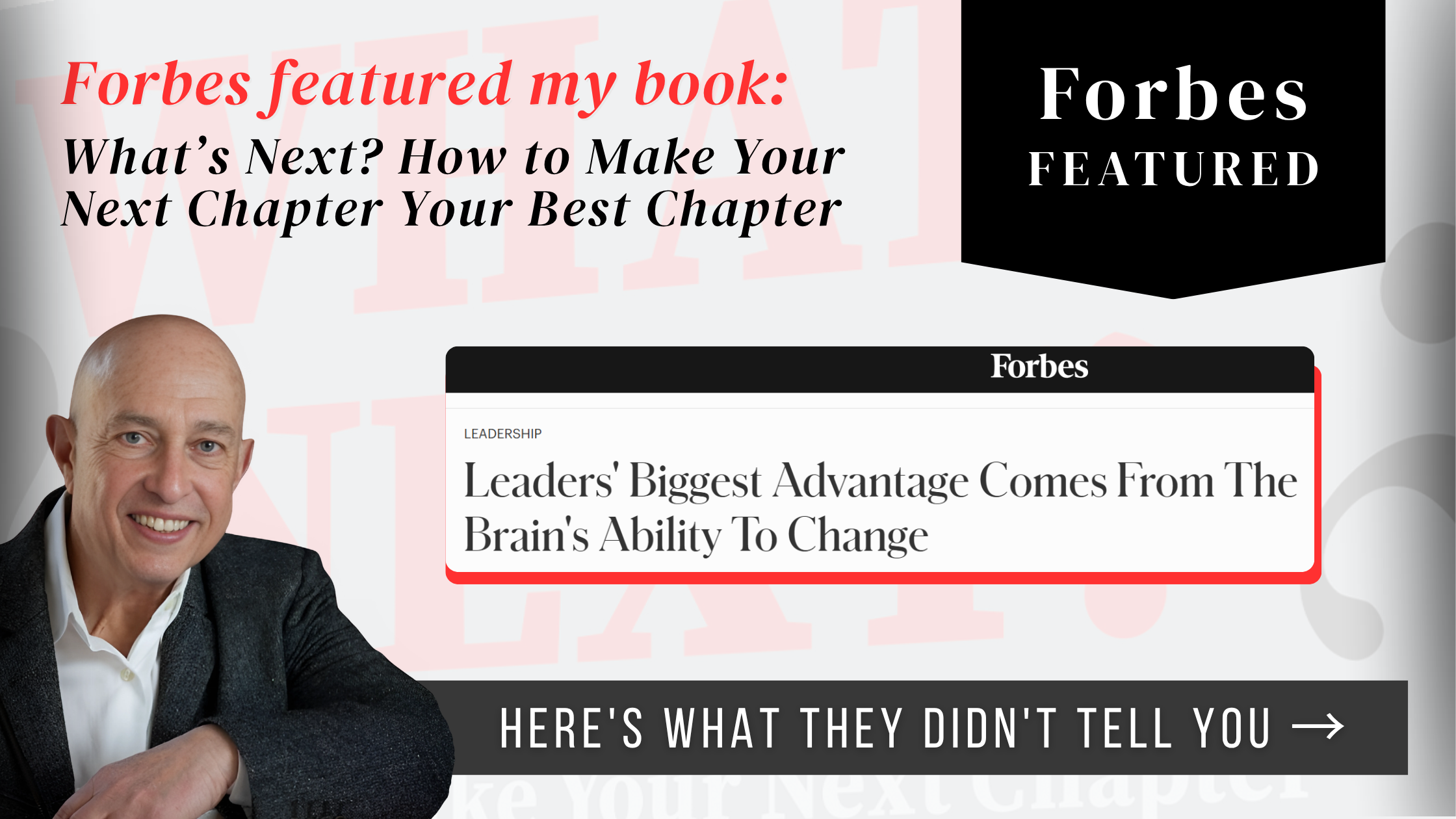
Forbes Just Featured The Magic Question from my book What’s Next? How to Make Your Next Chapter Your Best Chapter. Here’s What They Didn’t Tell You.
Forbes published an article about something I’ve been teaching for decades, a question so simple most people dismiss it the first time they hear it.
“What would it take?”
I call it The Magic Question, and it’s the backbone of my book What’s Next? How to Make Your Next Chapter Your Best Chapter.
The woman who wrote the article didn’t just write about the question. She used it. For three months, she applied it to every area of her life where she felt stuck — and it transformed her life.
But the Forbes article only scratched the surface of why it works. So let me take you deeper.
Your Brain Is Working Against You (And You Don’t Even Know It)
Ever since we became modern humans 300,000 years ago, our brains have been hardwired to resist change. Back then, that wiring kept us alive. Today, it keeps us stuck.
It starts in the amygdala — a small, almond-shaped cluster of neurons deep in your brain’s temporal lobe. The amygdala controls your emotions and stores emotional memories. It also triggers fear. And here’s the problem: your amygdala doesn’t distinguish between a genuine threat and the discomfort of doing something new. To your amygdala, uncertainty is danger.
We make emotionally driven decisions faster than ones that require thought and analysis. In ancient times, that speed kept us alive. Today, it means fear often reaches your awareness before reason does — and by then, the decision is already half-made.
This is why you feel that resistance when you think about a big life change. That’s not wisdom telling you to stay put. That’s a 300,000-year-old survival instinct doing exactly what it was designed to do: keep you still. The problem? In modern life, staying still is often the most dangerous thing you can do.
I call these hardwired instincts — the pull toward instant gratification and the avoidance of discomfort — your shadow values. They live in your unconscious mind, and they drive your decisions without you even realizing it.
How The Magic Question Actually Works
Here’s where most people get it wrong. They think change requires willpower — pushing through fear with sheer determination. But that’s fighting your brain. The Magic Question works with it.
When you ask yourself “What would it take?”, something remarkable happens. The question moves activity to your prefrontal cortex — your working brain. That’s the region where you process new information, solve problems, and learn. But there’s a gatekeeper standing in the way: your ego.
Your ego’s job is to protect you by protecting your self-image. And your self-image is built on your self-limiting beliefs. So every time you have a new thought, see a new opportunity, or face a new challenge that doesn’t fit who you believe you are, your ego steps in and gives you reasons to reject it: “You tried that before, it didn’t work. That’s not who you are. You’re not capable of doing that.”
This is why positive thinking alone doesn’t work. You can tell yourself “I’m going to change my life” all day long — but your ego will judge that thought against its existing picture of you and shut it down before you even start.
The Magic Question bypasses this entirely.
When you ask “What would it take?”, you don’t yet know the answer. And because you don’t know, there’s nothing for your ego to judge. It has no material to work with. So it goes quiet — temporarily — and in that silence, something extraordinary opens up: a blank canvas in your mind.
Your mind is suddenly free to play. Ideas that would normally be dismissed as impossible start flowing. Many will be too wild to pursue. But buried in there, you’ll find a few golden nuggets — ideas that, with some changes in your beliefs and behaviors and a little luck, just might work.
Those are the ones that change everything.
Your Brain Can Physically Rewire Itself
Here’s what fascinates me most about this process. It’s not just psychological — it’s neurological.
Neuroscience tells us that it’s possible to rewire portions of your brain through a process called neuroplasticity. The neural pathways you use most become stronger and faster. The ones you stop using gradually weaken.
When you’re stuck in old patterns — when your shadow values are running the show — your brain is likely receiving elevated levels of cortisol, the stress hormone that inhibits creativity. You’re literally in a chemical state that makes it harder to see new possibilities.
But when you start asking “What would it take?” questions and reflecting deeply on the answers, something shifts. With repetition and practice, your brain begins to form new connections. What once felt impossible starts to feel possible. What felt uncomfortable becomes your new normal. You move from clumsy to adequate to good — and eventually to a place you never imagined you could reach.
This is how reinvention actually works. Not through willpower. Through rewiring.
And it’s available to you at any age.
The Part Forbes Couldn’t Include
I’m 88 years old. I’ve spent decades asking leaders, executives, and people at every stage of life this one question. The answer is always different. But the shift — that moment when someone stops saying “I can’t” and starts asking “What would it take?” — that looks the same every single time.
It’s the moment everything changes.
And that moment is available to you right now.
So let me ask you what I’ve asked thousands of people before: What would it take?
Ready to find out? Download the free first chapter of What’s Next? ? billleider.com/social
Read the full Forbes feature ? Leaders’ Biggest Advantage Comes From The Brain’s Ability To Change
